山頭氣 — The Character of the Mountain
Have you ever tasted two oolong teas that seemed completely different, even though they were made from the same cultivar?
One may feel soft and floral.
Another may feel bright, fresh, or deeper in texture.
Sometimes, the difference begins with where the tea grows.
Taiwan is a small island, but its mountains are anything but small. The landscape rises dramatically from the coast toward the Central Mountain Range, creating tea-growing environments that can range from warm lowlands to cool, misty mountains above 2,000 meters.
Temperature changes.
Sunlight changes.
Rainfall changes.
Clouds, mist, soil, and surrounding vegetation change.
And the tea changes with them.
In Taiwanese tea culture, there is a beautiful word for this sense of place:
山頭氣 — shān tóu qì.
It can be loosely understood as "the character of the mountain."
山頭氣 is not simply an aroma or a single flavor. It describes the combination of fragrance, sweetness, texture, freshness, mouthfeel, and lingering finish that can give a tea a distinctive sense of where it was grown.
You may taste two teas made from the same cultivar and processed in a similar style, yet they can express very different personalities.
That is the idea behind tea terroir.
Tea Terroir: When Place Becomes Character
If you are familiar with wine, the concept of terroir may sound familiar.
The same grape can produce very different wines depending on where it grows. Tea works in a similar way.
The environment influences how the tea plant grows, while the tea maker determines how those leaves are transformed after harvest.
So a tea's character is shaped by several things:
Cultivar + Environment + Craftsmanship
The cultivar tells us what the plant is.
The environment tells us where it grew.
And craftsmanship determines how its potential is expressed.
This is why Taiwanese tea is often discussed by mountain name, not only by cultivar.
A tea drinker may not simply ask: "What cultivar is this?"
They may also ask: "Which mountain?"
Why Does Elevation Matter?
Elevation is one of the easiest ways to see how environment changes.
As elevation increases, temperatures generally become cooler, and tea plants tend to grow more slowly. Mist, cloud cover, sunlight, rainfall, and the surrounding ecosystem also change.
These conditions can influence the development of the tea leaf and, eventually, what we experience in the cup.
But there is an important distinction:
Higher does not automatically mean better.
A 2,500-meter tea is not automatically better than a 1,500-meter tea.
Altitude is an environmental factor—not a quality score.
The mountain provides the conditions. The tea maker brings the leaf to life.
Taiwanese Tea Mountain Profiles
Here are some of Taiwan's well-known high-mountain tea regions and the general characteristics you may encounter.
| Tea Region | Approx. Elevation | General Character |
|---|---|---|
| Alishan | 1,000–1,600 m 3,300–5,250 ft |
Floral, soft, sweet, smooth |
| Shan Lin Xi | 1,600–1,800 m 5,250–5,900 ft |
Fresh, structured, forest-like, lingering |
| Cuifeng | 1,800–2,200 m 5,900–7,200 ft |
Cool, clean, floral, refreshing |
| Lishan | ~1,800–2,600 m 5,900–8,530 ft |
Floral, bright, sweet, clear |
| Huagang | ~2,300–2,700 m 7,550–8,860 ft |
Delicate, aromatic, cool, refined |
| Dayuling | ~2,200–2,700 m 7,220–8,860 ft |
Fragrant, sweet, concentrated, persistent |
These are general tendencies, not fixed tasting profiles. Tea from the same region can vary depending on cultivar, garden location, harvest season, weather, and processing.
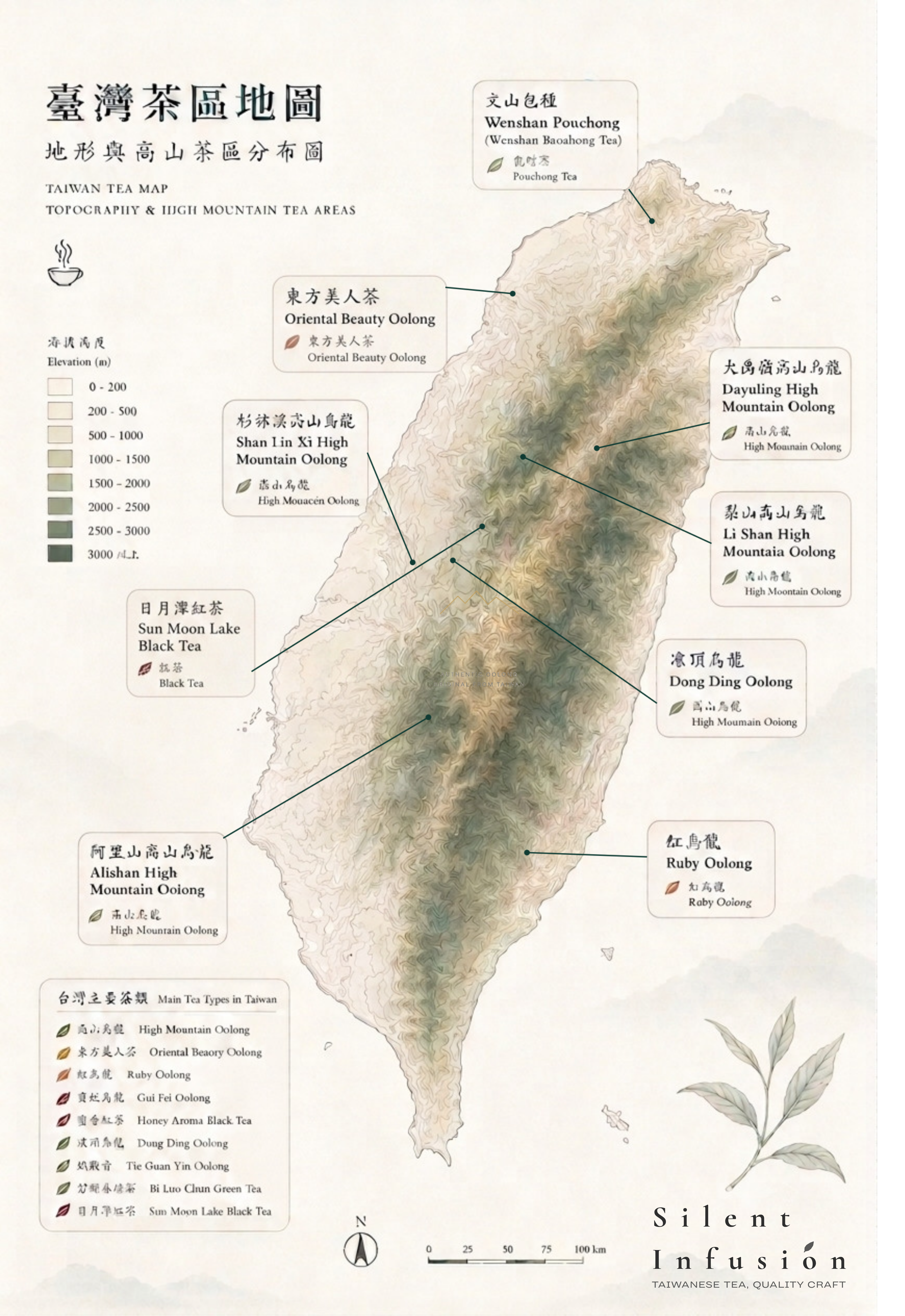
Taiwan Tea Map: Topography and High Mountain Tea Areas showing major tea regions and their elevations
Taste the Mountain
The next time you drink Taiwanese oolong, try something simple.
Before looking at the tasting notes, ask: Where was this tea grown?
Then slow down.
Notice the fragrance.
Notice the texture.
Notice the sweetness.
Notice what remains after you swallow.
You don't need to correctly identify the mountain.
You are simply learning to notice how place can appear in your cup.
That is the beauty of 山頭氣.
It is not one flavor.
It is not a number on a label.
It is a sense of place.
A reminder that before tea became something we drink, it was first something that grew somewhere.
The mountain gives the tea its starting point.
The tea maker helps reveal its character.
And when you take that first sip, you get to experience a little piece of the mountain for yourself.